Cornwell Solar

Project Details

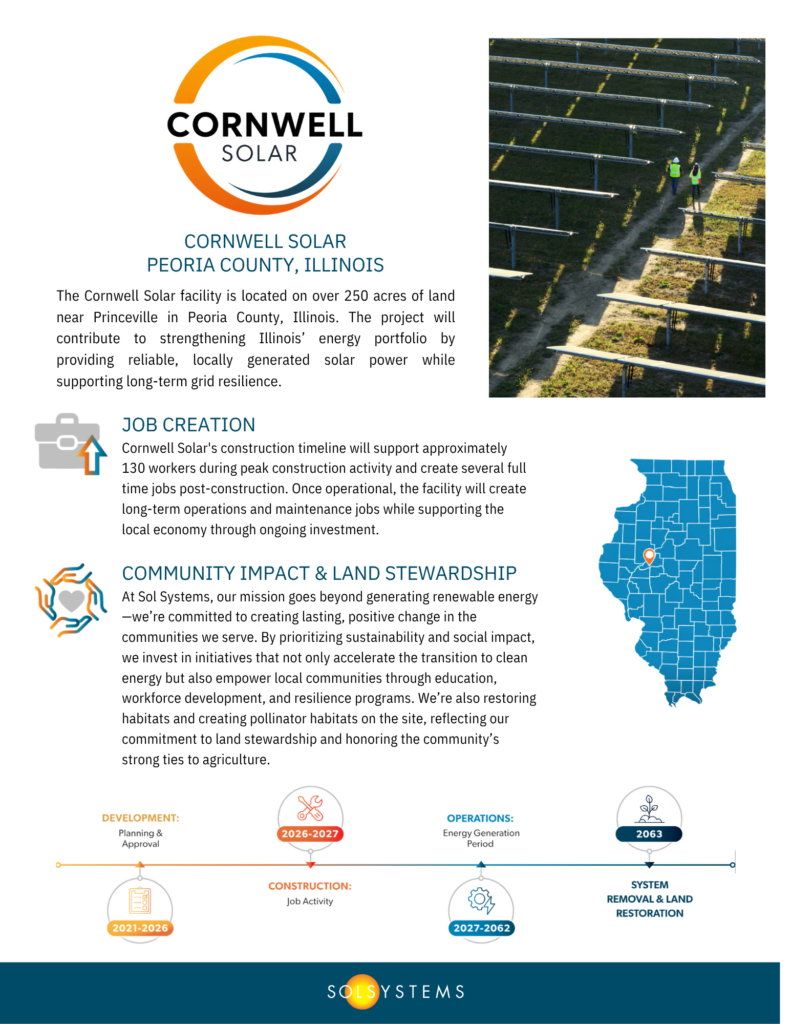
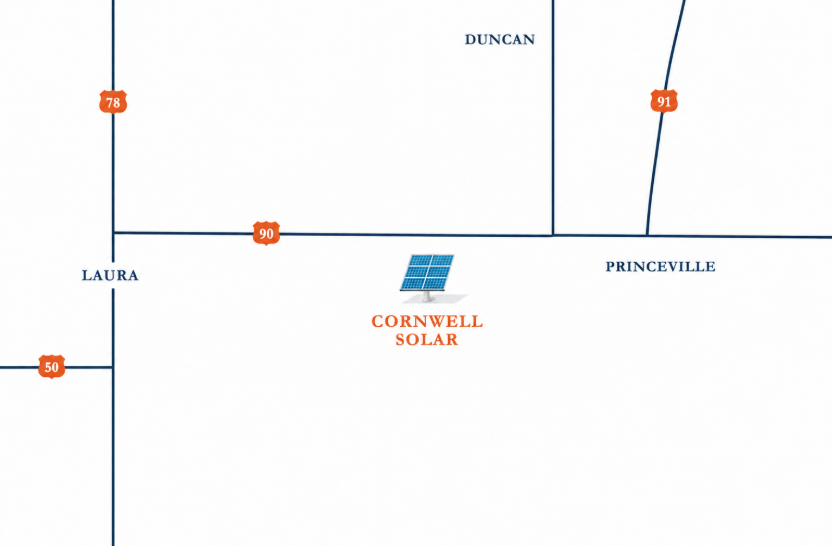
The 35 MWac Cornwell Solar Project is a photovoltaic solar facility planned for Peoria County. This project will contribute to diversifying Illinois’ energy mix by providing affordable, locally sourced solar power, enhancing grid reliability. Cornwell Solar utilizes cutting-edge solar technology and is designed to have minimal impact on the local environment.
Local Economic Benefits

Local Economic Benefits

Community Impact

At Sol Systems, our mission goes beyond generating renewable energy—we’re committed to creating lasting, positive change in the communities we serve. By prioritizing sustainability and social impact, we invest in initiatives that not only accelerate the transition to clean energy but also empower local communities through education, workforce development, and resilience programs. Discover why our focus on community partnerships and innovative solutions is central to our approach and how it’s shaping a more sustainable future here.

Economic & Environmental Benefits

Carbon Free

81,353 MWh carbon-free electricity each year

30,059 tons of CO2 emissions expected to be offset each year, equivalent to the emissions generated by 69,888 cars driven in one year. *EPA Calculator 

$7.7 million tax revenue

Expected to be generated in tax revenue for Peoria County & other local entities, over the life of the project, including $6 million to local school districts.

130 local jobs 

Expected to be created during peak construction and additional long-term operational positions during the operational phase.

Reduces C02 emissions

Reduces approximately 30,059 tons of carbon dioxide emissions annually.

ecosystem-impact-initiative

Ecosystem Impact Initiative

Sol Systems implements thoughtful, integrated land stewardship on each utility-scale project it builds. We are committed to habitat restoration, evaluating using grazing for vegetation management, and creating opportunities for farming

Landowners

As the demand for renewable energy grows, landowners have a unique opportunity to contribute to a cleaner future while benefiting from long-term, stable income. Solar energy projects can provide a sustainable use for large parcels of land, especially for those not currently in active agricultural use or areas with limited development options.

Sol Systems partners with landowners to carefully evaluate the suitability of land for solar development. Our team manages every step of the process, from initial feasibility assessments to the development and operation of solar projects. With a focus on environmental stewardship and community benefits, we ensure that projects align with both your goals and local needs.

Learn more about how solar energy can offer a sustainable future for your land.

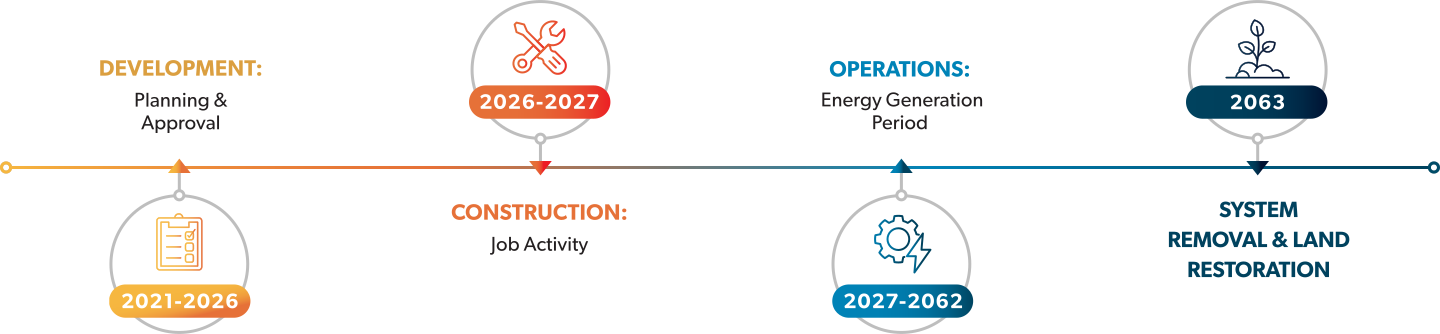
Project Timeline
Studies: Environmental & Technical

Our commitment to quality and sustainability at Sol Systems drives us to go above and beyond industry standards. As a part of best practices, Sol Systems conducts comprehensive environmental and technical assessments for our projects. These efforts include rigorous evaluations to ensure that every project is responsibly developed with minimal environmental impact and to proactively address potential concerns before moving forward. As part of the development process, Sol Systems engaged consultants to conduct environmental and permitting studies, including reviewing compliance with the Endangered Species Act, Bald and Golden Eagle Protection Act, State Historic Preservation Act, Clean Water Act, Illinois Solar Energy Facilities Agricultural Impact Mitigation Act, and others. Each study was reviewed by the Sol Systems team and an independent engineer to ensure construction and operations follow recommended best practices. Sol Systems commissioned a third-party consultant to conduct detailed natural catastrophe asset simulation modeling of the convective storm (combination of hailstorm, straight‑line wind, and tornado), hailstorm, straight‑line wind, and tornado risks for the project. The output from this study provides Sol Systems with information on the risk and potential losses to the solar project as a result of one of the natural hazards considered in this study.

By prioritizing these detailed studies, we maintain the highest level of due diligence, safeguard local ecosystems, adhere to best practices, and ensure the long-term viability of our projects. This proactive approach reflects our dedication to delivering clean energy solutions that benefit the environment and the communities we serve. We also ensure that we are listening to our stakeholders and communities around our projects. In the process of development, Sol Systems consulted or engaged with federal agencies, the Illinois Department of Agriculture, the Illinois Department of Natural Resources, Peoria County Planning and Zoning, Princeville Township, landowners, local elected officials, and community members. An independent engineer also reviewed Sol Systems’ practices for supply chain traceability and employee guidelines. Consultations have informed our development and construction process, ensuring that we are prioritizing community benefits and feedback and constantly improving conditions for our workers.

FAQ

  • How many jobs will this project create?


    A 35 MWac project should be able to create 130 jobs during the 12-month construction period, with approximately 2 full-time jobs for 30+ years
  • Are landowners compensated for leasing their property?


    Landowners generate a reliable, long-term source of income by leasing their property to solar development.
  • Will this project impact my monthly electric bill?


    Utility-scale projects have no impact on electric bills. The utility company provides electricity to its customers at a set price

  • Increased tax revenue for school districts, and county departments.
  • Expected increased local spending and sales tax revenue during the construction period.
  • Energy produced by a 35 MWac solar facility is approximately equivalent to greenhouse gas emissions of 7,235 homes’ annual electricity use.
  • Renewable energy projects assist states and utilities in meeting clean energy goals.

  • Can farmland be restored to agricultural use after decommissioning?

    Land can be converted back to agricultural use at the end of the facility’s life. Giving the soil 20-25 years of rest, or switching to a low-height crop rotation, can also maintain or improve soil quality.

    Dual use of solar power plants as biocrust nurseries for large-scale arid soil restoration – Nature Sustainability
    Effects of Revegetation on Soil Physical and Chemical Properties in Solar Photovoltaic Infrastructure – Frontiers in Environmental Science

  • What happens to the tenant farmers of leased solar land?

    If the landowners choose to lease the land for the lifetime of the solar farm (20-30 years), operations and maintenance of the land shift from the farmer to the solar company. Land leases typically generate more revenue than traditional crops, diversify your income, and remove the risk of poor yield years.

  • How is vegetation managed under the panels?

    With leased land, the leasing party (i.e. utility company/project owner) is usually responsible for upkeep. Many options are available for weed control including herbicides, grazing animals, mowing, and weed control sheets.

  • Can farming continue on farmland leased to solar development?


    Agrivoltaics pair solar with agriculture, creating energy and providing space for crops, grazing, and native habitats under and between panels. Many native plant species and partial-sun crops can grow well under PV panels. In dry areas, some crops even grow better in the shade of PV than in an open field.
    Sheep are commonly used for grazing vegetation control at solar facilities, reducing mowing, herbicide, and other vegetation management practices.
    Agrivoltaics: coming Soon to a Farm Near You? – U.S. Department of Agriculture
    Smart Solar Siting for New England, What is Dual-Use Solar? – American Farmland Trust
    Researchers explore dual-use options for solar – Farm Progress

  • Are solar panels toxic?

    No. Solar panels will not harm people, water, or soil. There are no studies indicating negative health impacts from a solar project site. The compounds within solar panels – Cadmium Telluride, Silicon, and others – do not leech, escape, or leak, from solar panels even during extreme weather conditions that damage panels. Materials inside a solar panel are solid and fully encapsulated in tempered glass. All solar panels used by Sol Systems pass the EPA’s Toxic Characteristic Leaching Procedure (TCLP) test, are classified as non-hazardous, and are not regulated as toxic materials. Health and Safety Impacts of Solar Photovoltaics, North Carolina State Extension Publications
    Assessment of the Risks Associated with Thin Film Solar Panel Technology – The Virginia Center for Coal and Energy Research

  • What are solar panels made of?

    Crystalline-silicon solar modules are largely made of glass, aluminum, copper, and silicon, along with other commonly used plastic and wires. The cells on solar modules that are used to capture sunlight are made of silicon, which is a naturally occurring element. Crystalline-silicon solar modules are made of basic “solid-state” materials, meaning there are no liquid or gaseous components. 

  • Are solar panels noisy?

    No. Inverters used in solar panels can generate a quiet low buzzing sound as they convert DC to AC. The noise generated is generally not audible over ambient noise (rustling wind, birds, traffic, etc.)

  • Will solar panels produce a bad glare?

    Solar panels are intended to capture the most light possible and are designed to reduce reflection and glare. Modern solar panels reduce reflection using anti-reflection coatings (ARC) and texturing the surface. According to the National Renewable Energy Laboratory, solar panels reflect as little as 2% of incoming sunlight and produce less glare than standard windows and water. The Federal Aviation Administration (FAA) produced a final policy report that found solar projects do not create hazardous glare for aircraft in the area.

To top